Corporate films · GuideHow to Write a Corporate Video Script
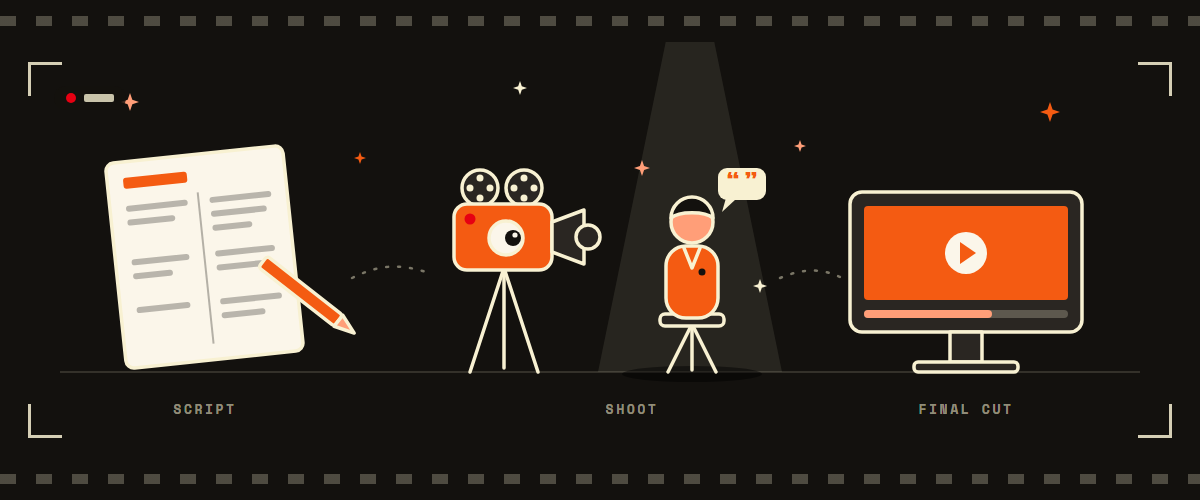
To write a corporate video script, first decide who is watching and what you want them to do next. Then write in five parts: a hook, the problem or context, who you are and how you work, proof, and one next step. Use the two-column format (what we see on the left, what we hear on the right), allow about 150 spoken words per minute, and script questions for real people instead of lines.
Most corporate videos that fail were broken at the script. They try to say everything, so viewers remember nothing. A good script is mostly decisions made before any writing starts. This guide walks through those decisions, the structure that works for most company films, the format crews actually shoot from, and a template you can copy.
Before you write: answer four questions
Write the answers at the top of your script document. Every later choice gets checked against them.
- Who is watching? A buyer comparing suppliers, a candidate deciding whether to apply, and an investor reading a deck need different films. Pick one primary viewer.
- What should they do next? Book a call, apply, request a quote, trust a partner. One action, not three.
- Where will it play? A website hero, a sales meeting, LinkedIn or a trade-show screen. That decides length, whether it needs to work without sound, and the aspect ratio.
- What proof do you have? Customers who will speak, projects you can film, numbers you can show. Proof you can put on camera beats any claim you can write.
The five-part structure
This structure fits company profiles, brand films and most corporate videos. The timings are for a two-minute film; scale them for shorter or longer ones.
1. Hook (0:00 to 0:10)
Open on something the viewer recognises: their problem, a striking image from your work, or a line from a customer. Don’t open on your logo or “Welcome to…”. You have a few seconds before people decide whether to keep watching.
2. Problem or context (0:10 to 0:30)
Name the situation your customers are in before they find you. This is what makes the rest of the film feel relevant rather than like an advert.
3. Who you are and how you work (0:30 to 1:15)
Show the people, the place and the process. Pick two or three things that genuinely set you apart and show each one on screen. Cut everything you would only be saying because competitors say it.
4. Proof (1:15 to 1:45)
Customers in their own words, finished projects, before-and-after results, certifications in context. This is the section that does the convincing; protect its time when the edit runs long.
5. One next step (1:45 to 2:00)
Tell the viewer exactly what to do and where: “Message us on WhatsApp for a site visit” beats “Contact us today”. Put the same action on screen as text.
Use the two-column format
Corporate video scripts are written in two columns, often called an AV script. The left column is what we see; the right column is what we hear. Writing both side by side stops you describing in words what the picture already shows, and it is the format a crew can plan a shoot from.
Corporate video script template
Copy this into a document or spreadsheet and fill one row per scene.
| Scene · time | Visual (what we see) | Audio (what we hear) |
|---|---|---|
| 1 · Hook 0:00–0:10 | [The most striking real moment from your work] | [One line: the viewer’s problem or a customer quote] |
| 2 · Context 0:10–0:30 | [Your customer’s world before they find you] | [Voice-over or interview: the situation they’re in] |
| 3 · Who we are 0:30–1:15 | [People, place, process: two or three differentiators, shown] | [Founder or team interview answers; keep voice-over short] |
| 4 · Proof 1:15–1:45 | [Customers, finished work, results on screen] | [Customer interview answers in their own words] |
| 5 · Next step 1:45–2:00 | [Contact action as on-screen text, logo last] | [One clear instruction: what to do and where] |
A worked example
Here is the opening of a 60-second company profile for a fictional furniture manufacturer, to show how the two columns work together.
| Scene · time | Visual | Audio |
|---|---|---|
| 1 · 0:00–0:06 | Close-up: a hand runs along a teak table edge in a finished living room. | Customer (interview): “We’ve moved house twice. The table came with us both times.” |
| 2 · 0:06–0:18 | Wide: the workshop at 7 a.m., lights coming on, timber stacked to dry. | Voice-over: “Most furniture is built to be replaced. Ours is built to be moved.” |
| 3 · 0:18–0:40 | A craftsman fits a joint by hand; the founder checks a finished piece. | Founder (interview): “Every joint is fitted by hand, and nothing leaves until I’ve sat at it.” |
Notice that the audio never describes what the picture shows. The picture proves the claim; the words give it meaning.
Writing for real people on camera
If customers, staff or your founder appear, don’t write their lines. Scripted words from non-actors sound scripted, and viewers notice. Instead:
- Write the questions you will ask, in the order that builds the story.
- Write the answer you hope for in your planning notes, so you know when you have it.
- After the shoot, transcribe the interviews and build the final script from their real words.
That is how most testimonial and corporate films are made: the script is finished in the edit, from what people actually said.
How long should the script be?
Spoken English runs at roughly 150 words a minute, a little slower for voice-over that needs room to breathe. A two-minute film is about 250 to 300 words of audio. If your draft is 600 words, it is a five-minute film or, more likely, two films.
Common mistakes
- Listing every service. Pick the two or three that matter to this viewer; link to the rest.
- Writing for reading, not hearing. Read every line aloud. If you stumble, rewrite it shorter.
- Jargon and claims. “Best-in-class, end-to-end solutions” says nothing. Show a real example instead.
- No proof. A film with no customers, results or real work on screen is an advert, and viewers treat it like one.
- Too many next steps. One action. Repeat it on screen.
We start every corporate film by finding the stories worth telling, then script around real people and real proof, so the film is built for the decision your viewer is making.
Script Questions
How do you write a corporate video script?
Decide who is watching and what they should do next, then write in five parts: a hook, the problem or context, who you are and how you work, proof, and one next step. Use a two-column format with visuals on the left and audio on the right, and script interview questions rather than lines for real people.
What is the format of a video script?
Most corporate and commercial video scripts use a two-column format, also called an AV script: the left column describes what is on screen, the right column holds the voice-over, dialogue or interview audio, with one row per scene and a time for each.
How many words is a 2-minute video script?
About 250 to 300 words. Spoken English runs at roughly 150 words a minute, and voice-over usually needs pauses, so plan for slightly fewer words than the maximum.
Should you script interviews in a corporate video?
No. Script the questions, not the answers. People reading lines sound unnatural on camera. Interview them, then build the final script from their real answers in the edit.
Or write to zenarchproductions@gmail.com · DM us @zenarch.productions